
By Reese's Purpose • July 1, 2026

When we talk about drowning prevention, we usually focus on supervision, fences, and swim skills, and those matter most. But there is another layer most parents don't think about:
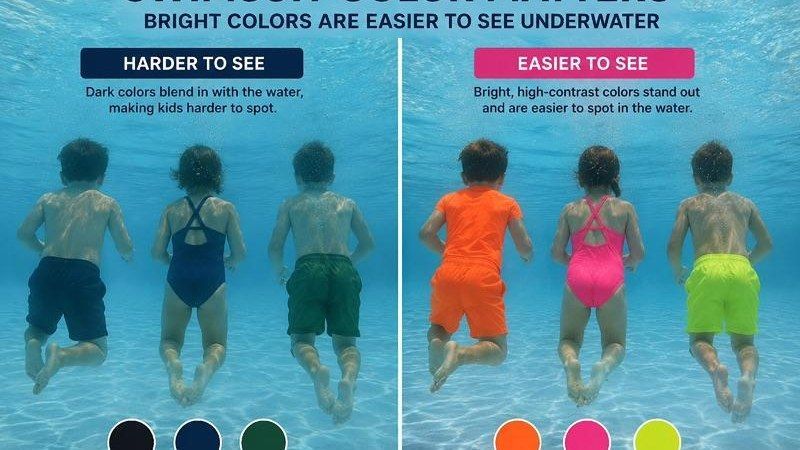
What a child wears in the water can affect how quickly they are seen.
Drowning is fast and often silent. In those moments, visibility can matter in a critical way.
Why Color Matters in Water
Water changes how we see things. Light, movement, and contrast all shift depending on where a child is swimming.
- In pools, glare and reflections can make pale colors harder to distinguish
- In lakes or natural water, darker environments can reduce contrast even further
- From a distance, movement is easier to detect when there is strong color contrast
This is why lifeguards are trained to look for contrast and motion, not just shape.
What Tends to Stand Out Most
There is no perfect swimsuit color that guarantees visibility in every situation, but some patterns are consistently easier to spot in water:
Bright, high-contrast colors (like neon orange, bright pink, or neon green) often stand out more quickly than dark or muted tones.
Colors that can blend in more easily include:
- Black or dark blue
- Deep green or earth tones
- Very light colors in bright glare
A helpful question when choosing swimwear is:
"Would I be able to spot my child quickly if they were under the water?"
That one question changes how you look at color completely.
One Important Reminder
Swimsuit color is not protection on its own.
It works only as one small layer alongside:
- Constant, undistracted supervision
- Pool fences and barriers
- Swim readiness and water skills
- Life jackets in open water
The Takeaway
Drowning prevention isn't one action. It's a system of small protections working together.
Even something as simple as color can support faster recognition in an emergency.
Because in water safety, seconds matter, and visibility matters too.
Insights to fuel your marketing business
Sign up to get industry insights, trends, and more in your inbox.
Contact Us
We will get back to you as soon as possible.
Please try again later.
SHARE THIS
Latest Posts
Stay close
We send a note when something changes. New legislation. A serious recall. A new partner. A milestone in the work. No spam. Just a word directly from us.
Suspect a child has swallowed a button battery?
Time matters. A button battery lodged in a child's esophagus can cause serious tissue damage in two hours. Do not wait for symptoms. Call the National Battery Ingestion Hotline immediately, and go to a hospital emergency department that has both an operating room and X-ray capability.